a1

Friday, 19 February 2016

Scients Created New "Superman Crystal" Disc,We Can Store 360TB For 13.8 billion years.


Want to make sure you back something up indefinitely? Then you could do worse than a new digital data storage technique that uses laser light to store 360 terabytes of information on nanostructured quartz for up to 13.8 billion years.

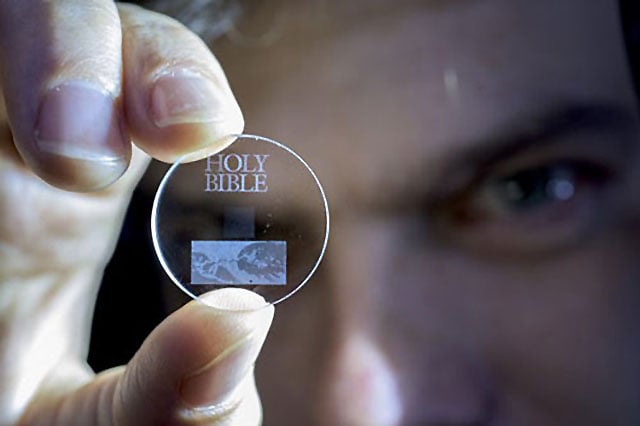
Developed by researchers at Southampton University in the UK, the technique uses femtosecond laser pulses to write data in the 3D structure of quartz at the nanoscale. The pulses create three layers of nanostructured dots, each just five microns above the previous. The changes in the structure can be read by interrogating the sample with another pulse of light and recording its polarisation -the orientation of the waves-after it's passed through.
The team has now written a series of major works to small glass discs- including the Universal Declaration of Human Rights, Newton's Opticks, the Magna Carta and the Kings James Bible. The density of the data aboard these discs suggests that they could squeeze a total of 360 terabytes onto a single piece of quartz. They also point out that the data is extremely stable: It could endure for as long as 13.8 billion years at temperatures up to 350 degrees Fahrenheit.
The idea of archiving data in this way has been around for a little while, but until now the density of data storage has been modest. Back in 2012, a similar technique was used to store 40 megabytes per square inch -approximately the same density of a music CD. The new advance, though, makes the technique a genuine means of archiving vast quantities in perpetuity.

Monday, 15 February 2016

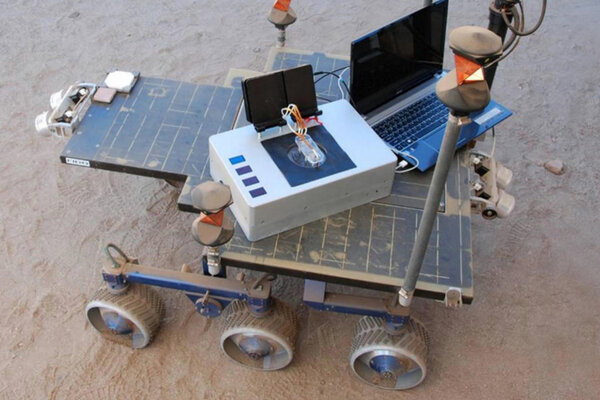
Chemical Laptop, that could be used to search for signs of life outside Earth.

If you were looking for the signatures of life on another world, you would want to take something small and portable with you. That’s the philosophy behind the “Chemical Laptop” being developed at NASA’s Jet Propulsion Laboratory in Pasadena, California: a miniaturized laboratory that analyzes samples for materials associated with life.
“If this instrument were to be sent to space, it would be the most sensitive device of its kind to leave Earth, and the first to be able to look for both amino acids and fatty acids,” said Jessica Creamer, a NASA postdoctoral fellow based at JPL.
Like a tricorder from “Star Trek,” the Chemical Laptop is a miniaturized on-the-go laboratory, which researchers hope to send one day to another planetary body such as Mars or Europa. It is roughly the size of a regular computing laptop, but much thicker to make room for chemical analysis components inside. But unlike a tricorder, it has to ingest a sample to analyze it.
“Our device is a chemical analyzer that can be reprogrammed like a laptop to perform different functions,” said Fernanda Mora, a JPL technologist who is developing the instrument with JPL’s Peter Willis, the project’s principal investigator. “As on a regular laptop, we have different apps for different analyses like amino acids and fatty acids.”

Amino acids are building blocks of proteins, while fatty acids are key components of cell membranes. Both are essential to life, but can also be found in non-life sources. The Chemical Laptop may be able to tell the difference.

Saturday, 13 February 2016

Samsung launches Chromebook 3 under $200.

At CES last month, Samsung revealed that its follow-up to its well-reviewed Chromebook 2 would be making its way to market in 2016. Now it seems that day has arrived, as the Korean electronics company has listed the Chromebook 3 on Adorama, complete with an economical $200 price tag.
Of course, with the low price comes equally low specs, with the entry-level model wrangling in an 11.6-inch matte display with 1,366 x 768 resolution, an Intel Celeron N3050 Braswell processor, an Intel HD Graphics GPU, 2GB of RAM, and 16GB of storage. It’s worth noting, however, that the company plans on adding a model with 4GB of RAM later on down the road.
On top of that, you can expect the Chromebook 3 to have a built-in 802.11ac Wi-Fi chip, and USB 3.0, in addition to Bluetooth 4.0, a pair of stereo speakers, a microSD card slot, and an HDMI port.

Distinguishing itself from previous models, the Chromebook 3 has installed a set of UL-certified key caps on its ergonomic keyboard, keeping up the ongoing trend of comfort for Samsung’s lightweight budget laptop series.
Obviously, these specs weren’t devised to impress, but the sturdy magnesium frame that houses the machine is a nice touch if you’re planning on throwing your laptop against the wall out of sheer frustration. All kidding aside, the finish was designed for those involved in schools and businesses, intended to endure some light roughing up.
If you’re curious about its size, the Chromebook 3 measures 0.7 inches thick, weighing it at about 2.5 pounds. Battery life-wise, you’re looking at up to 11 hours, according to the manufacturer. That’s quite good, if the real-world use comes close to the claim. A lot of Chromebooks can manage six or seven hours, at best.
Obviously, being a Chromebook, you can expect it to run Google’s simple Linux-based operating system, including all the cloud-based productivity tools you’ll need to get your work done. If you’re looking for something cheap and durable to get you by, Samsung’s Chromebook 3 looks to offer just that and a little more.